-
 Kids will learn all about electricity and magnetism through these fun and easy-to-follow experiments.
 -
 Kids will learn all about forces through these fun and easy-to-follow experiments.
 -
 Kids will learn all about heat through these fun and easy-to-follow experiments.
 -
 Kids will learn all about light and sound through these fun and easy-to-follow experiments.
 -
 Kids will learn all about plants through these fun and easy-to-follow experiments.
 -
 Kids will learn all about solids, liquids and gases through these fun and easy-to-follow experiments.
 -
 Aircraft carriers are truly the fortresses of the sea! Students will get an inside-out view of these incredible floating cities, from how they are constructed to how they function as important parts of a country's defense. Students also will learn about the various aircraft that are on board and the crew that keeps aircraft carriers in ship shape!
 -
 Your readers will get a close look at planes such as the Airbus A380, which is the world's largest airliner, and the Lockheed Martin F-35B, which is a short take-off and vertical landing combat aircraft. Readers learn about the engine and design that make flight possible for each aircraft.
 -
 In 1878 in Denison, Texas, a man named John Martin looked up into the sky and saw something he could not explain. Americans have been hooked on the possibility of beings from space visiting Earth ever since. A sense of wonder, and reality, are brought to some popular legends of alien encounters and sightings in this volume. The final chapter explores how these legends have become even more popular thanks to movies, television, and literature.
 -
 This fascinating book explores the history and work of astronauts, the rigors of astronaut training, and what it is like to live and work in space. Brief bios on our most famous astronauts are also included.
 -
 This colorful book explores the history and function of satellites and how they have helped scientists explore outerspace. Readers will also learn that we rely on satellites for communications, mapping, and many other things.
 -
 Your curious readers will learn that going into space is no small endeavor. This book explains the history and function of space missions and how they have expanded our knowledge of the universe.
 -
 Bundle up for a fact-finding mission to the Arctic. Readers will learn about Arctic plants and animals, and how they depend on each other for survival in the coldest ecosystem on Earth.
 -
 Venezuela's Angel Falls is 16 times higher than Niagara Falls! Angel Falls will capture young readers' attention with its unique history and dizzying heights.
 -
 Because of the biological similarities between many animals and humans, scientists can learn about diseases, and find out how humans might react to medicines, cosmetics, chemicals, and other products by testing them on animals first. According to the Humane Society of the United States, more than twenty-five million animals are used in research, testing, and education each year. Readers learn about the various philosophies on animal testing, what tests are used, and how they are performed. The book presents the pros and cons of animal testing and some of the alternative methods to animal testing that scientists are developing today.
 -
 Imagine being in a place where the temperature can drop to -125 degrees Fahrenheit! That's how cold it can get on the world's biggest glacier. Students will be transported to the icy chill of Antarctica in this cool book.
 -
 Artificial Intelligence is one of the most intriguing and difficult technological advances ever explored by man. It is the study of intelligent behavior and the attempt to recreate it through technology. This beginner's guide explores, not only the technology behind AI, but the current and future benefits of further exploration.
 -
 The largest continent in the world also has the largest variety of people, land, and animals of any continent on Earth. Students will be delighted with the beautiful images as they read about this bountiful continent.
 -
 SIN DESCRIPCION
 -
 As the world's population expands, so too does the risk of communicable disease and global pandemics. Consequently, healthcare has assumed a greater centrality in the public consciousness both in the United States and around the world. With various national and international organizations dedicated to epidemiological research and disease control, societal welfare has become an increasingly significant aspect of public policy. The historical, legal, and scientific factors that form the basis of public health locally and globally are the subjects of this relevant and revealing volume.
 -
 The detailed illustrations and photographs in this fascinating book take us into the complicated, hectic world of the beehive, where we observe the rigidly structured "class system" of the honeybee, with its worker bees, drones, and queen. The complex body and internal systems of the bee are examined, as the history, honey production, construction of the honeycomb, reproduction, and colony building are discussed.
 -
Sin stock
 Luis loves to read, but soon his house in Colombia is so full of books there's barely room for the family. What to do? Then he comes up with the perfect solution: a traveling library! He buys two donkeys, Alfa and Beto, and travels with them throughout the land, bringing books and reading to the children in faraway villages. Beautiful!
 -
 Did you know that riders had to use stepstools to get onto the first bikes? Bicycles were once regarded as a nuisance to horses. Read about how they've become a significant part of our lives.
 -
 This book explains the latest scientific thought behind biodiversity and why a variety of species on our planet is essential. Further, the author explains recent efforts to preserve our world by curbing global warming.
 -
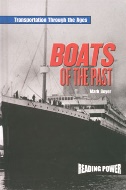 Humans have used boats for hundreds of years. See how boats have changed into the mighty ocean-going vessels we use today.
 -
 Imagine traveling at half the speed of a jet plane without ever leaving the ground! Students will discover the technology that makes such speeds possible, from special tracks and safety precautions to aerodynamically designed trains. What are the limits to the speed of trains? What imposes those limits? Students also will read about the future of passenger train travel, from flying trains to trains that use huge magnets to levitate inches or centimeters off the track. Some trains safely reach speeds of more than 200 mph!


